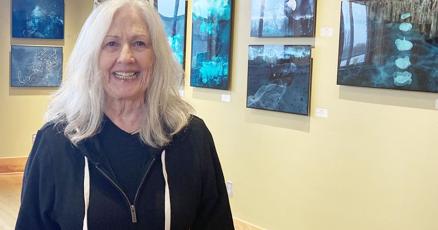
FERNDALE — Art is Robbie Reid’s life. She’s spent the past six decades studying, creating and teaching it, as both a career and as a magnificent obsession. The professor emeritus of art and art history now uses her expertise as a volunteer for the Jansen Art Center in Lynden, while also painting herself.
“Retiring from teaching has allowed me to devote more time to painting, something that I’ve always longed to do,” Reid said.
It’s something which runs in Reid’s family, back to her grandfather Robert Reid, a lithographer based in Seattle and later San Francisco.
“I earned graduate degrees in Art History at Stanford and the University of California, and I’ve studied painting and drawing at the undergraduate level and in numerous workshops and classes,” said Reid of her CV. “I spent eight years in Europe, painting and drawing as well as visiting art museums and historical sites before returning to complete my degrees. I was equally motivated to develop my abilities to think critically and articulate my ideas about art.”
Reid’s art education career saw her teach at Stanford University, UC Santa Barbara, Santa Barbara and Ventura city colleges and St. Cloud State University. Before she retired, Reid was a tenured professor at Foothill College in Los Altos Hills, which is in northern California.
“I have lectured at fine arts museums and galleries throughout my academic career, and I’ve shown my paintings in faculty exhibits and galleries,” Reid said.
As with any evolving artist, her interests and styles have shifted over time, responding to circumstances both internal and external.
“During the period of isolation and threat brought on by the pandemic, my palette darkened, and I focused on a series of detailed abstractions titled ‘Tree Being(s)’ and ‘Treescapes’ – paintings of scarred and wounded tree bark, imperiled surfaces which simultaneously exhibited the potential for survival. More recently, following the loss of a friend, I commemorated her courageous passing in a work titled ‘Valkeries,’ which was inspired by a photograph she’d taken of misty trees at sunset in Ferndale field. My current paintings are organic abstractions based on observations from nature. These expressive abstractions are my meditation on the transformative and interconnected nature of all life,” Reid said.
Her decades of experience have made Reid a great asset to the Jansen Art Center, colloquially called the J.
“As a member of the exhibits committee at the J, I serve as part of a team working with exhibits director Terry Redden to select and install artwork for quarterly juried exhibitions of art by regional artists,” Reid said. “I’m also working with Terry to develop educational field trips to the J’s art exhibits for local students.”
She first learned about the J from two of her sisters, Lynden residents Bonnie Jameson and Jeanne McGirr.
“I visited the J when I moved to Ferndale in 2023 and I immediately felt drawn to the beautiful historic building, the quality of the art exhibitions, and the overarching mission of the J to provide a welcoming venue for community access to art exhibits, concerts and a variety of classes in the arts,” Reid recalled.
She views the J as an important fixture in the Lynden community.
“I think one of the greatest achievements of the J is that it provides free public access to events including art exhibits – and there are scholarships for those who wish to take classes,” she said. “Art enhances our lives today and art centers like the J encourage each person in the community to participate – as visitors to concerts and exhibits, volunteers, and people of every age who want to learn more about textiles, jewelry, ceramics, theatre, music and studio arts.”
Her years spent behind both the lectern and the easel have given Reid a firsthand insight into how the art world has changed.
“Art education is more inclusive, more interactive and participatory than when I began my studies,” Reid opined. “Today’s classrooms are more about dialogue and differing points of view and questions are encouraged. Multicultural studies have broadened our notions of cultural production and deepened our understanding of what we think of as art. Art is no longer elevated to a pedestal where it can only be appreciated by an elite few.”
Reid sees art as a form of community building, and bridging gaps between generations and demographics.
“We all begin life as creative beings and those of us who continue in the visual arts share a commitment to communication and imagination, to developing a non-verbal language that speaks across the borders that might otherwise divide us,” Reid said. “I have worked with younger people, mostly college students, throughout my career and I have found that art creates a common ground for dynamic interchange of ideas between the generations.”
She views art and people’s reaction to it, emotional or intellectual or otherwise, as a universal experience all people can connect with.
“We all feel the thrill of looking at a powerful painting or a multi-media installation; we are moved by evocative music or haunting cinema,” Reid said. “We find shared humor, sorrow, and a whole host of emotions when we experience artworks that capture our imagination and remind us of our shared humanity. Whether art is beautiful or painful to experience, on some level it elicits communication and unites us in dialogue, whatever our age, background, or individual reactions.”
She hopes to use her position at the J to continue to teach art through community outreach: “My overall vision is to help with community outreach in the development of programs that bring local students into the art center to view and interact with actual works of art, and to assist in promoting the Jansen Art Center mission to create an exciting, engaging, welcoming space where the lives of visitors are enhanced by the imaginative contributions and hard work of artists, staff, and volunteers.”
.


